
Renting an Apartment in Qatar: Tenancy Contracts, Deposits and Tenant Rights (2026)

Every year, thousands of expats sign a tenancy contract in Qatar without reading it properly, and a good number of them regret it. The most common story sounds like this: the landlord keeps the deposit, the tenant has no written contract, and suddenly there is nothing to enforce.
This guide walks you through renting an apartment in Qatar the right way: what a tenancy contract must include, how lease registration works under the new 2026 rental law, deposits, break clauses, your rights as a tenant, and what to do when things go wrong. It is written for newcomers signing their first lease and for residents who want to stop making expensive mistakes.
The Law Behind Your Lease: What Changed in 2026
Tenancy contracts in Qatar are governed by Law No. 4 of 2008, which was amended by Law No. 8 of 2026. The new law took effect on September 3, 2026, and it changed three things every renter should know.
Registration fees under the 2026 law
First, lease registration now carries a fixed administrative fee of QAR 250 per unit, on top of the existing registration fee of 1% of the annual rental value per year.
Exclusive jurisdiction of the disputes committee
Second, the Rental Disputes Resolution Committee now has exclusive jurisdiction over landlord and tenant disputes, which means your registered contract is your ticket into the dispute system.
State-property registration deadline
Third, leases involving state property must be registered within two months of signing.
The practical takeaway is simple: an unregistered lease leaves you exposed. Register the contract, and the dispute committee will hear your case. Skip registration, and even a legitimate complaint can be thrown out.
Why a Written Tenancy Contract Is Non-Negotiable
A real community question from the Expat.com Doha forum tells the story: a tenant whose landlord threatened to keep the deposit had no written contract at all. Without a written, registered tenancy contract in Qatar, getting a deposit back is close to impossible, because there is no agreed record of what was paid, what condition the flat was in, or what the refund terms were.
Always insist on a written contract in both Arabic and English before you pay anything. Verbal promises from agents and landlords are worth nothing when money is on the line. If a landlord resists putting terms in writing, treat that as a warning and keep looking.
Lease Registration: What It Is and How It Works

Who registers and what is submitted
Qatar requires landlords to register lease contracts with the Office for Registration of Lease Contracts at the Ministry of Municipality, a process commonly called tawtheeq (authentication) of the rental contract. Registration is the landlord’s legal duty, not the tenant’s, but it protects you directly.
Fees and fines for late registration
To register, the landlord submits the signed contract along with ownership documents and identification, and pays the registration fees. Under the 2026 rules, that means the QAR 250 administrative fee plus the annual fee of 1% of the rental value. Landlords who fail to register within the required period can face fines of up to QAR 10,000.
Proof tenants should ask for
As a tenant, ask for proof of registration after you sign. A registered tenancy contract in Qatar is what gives you standing before the Rental Disputes Resolution Committee if a dispute ever arises. An unregistered contract can be rejected by the committee entirely.
Deposits: How Much, and How to Get Yours Back
How much and when it is refundable
The security deposit is the number one source of rental fights in Qatar, so get this part right. Most landlords ask for one month’s rent as a security deposit. It is refundable at the end of the lease, provided the flat is returned in good condition.
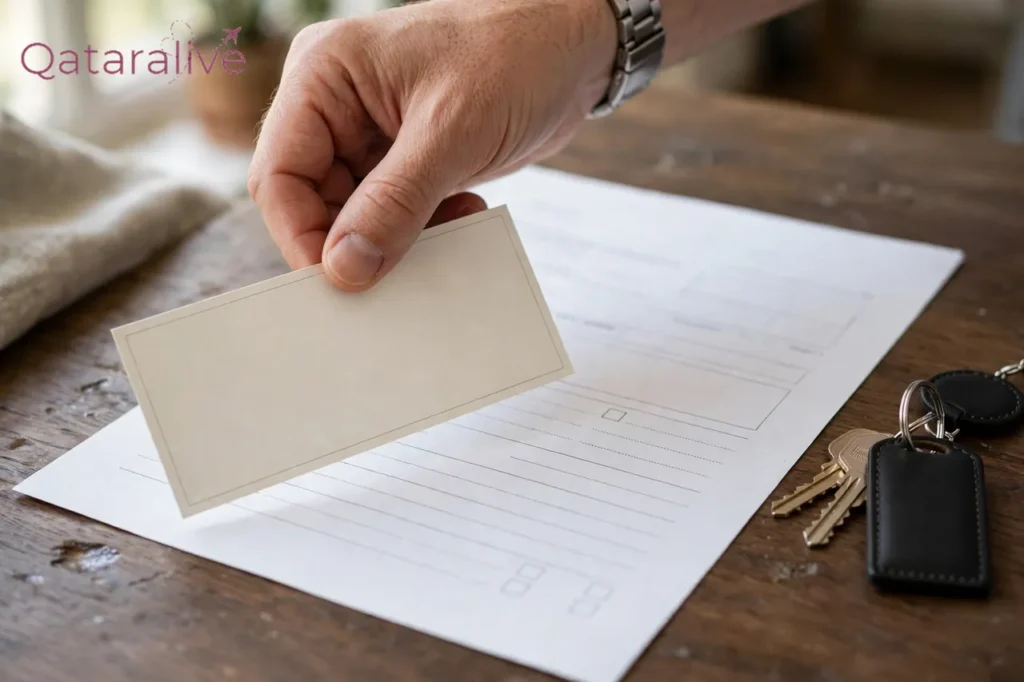
Photo evidence on move-in and move-out
Make sure the deposit amount, the conditions for its return, and the deductions allowed are written into the contract. Take dated photos or a video of every room on move-in day, and do the same on move-out day with the landlord or agent present. Normal wear and tear is not damage, but without photos you will struggle to prove it.
How to pay safely
Never pay a deposit in cash without a signed receipt. A bank transfer leaves a record; a handshake does not. This single habit would have saved the forum tenant who lost their deposit with no contract to point to.
What to Check Before You Sign
Do not sign at the viewing. Take the contract home, read every clause, and check these points against the actual flat.
Authorisation and utilities
Verify that the person you are dealing with is authorised to rent the property. Ask to see the landlord’s ID and proof of ownership, or the agency’s authorisation. Confirm whether utilities are included: electricity, water, cooling, and internet are usually billed separately in Qatar, and cooling charges in particular can be a nasty surprise.
Inspecting the flat
Inspect the flat properly. Run the taps, flush the toilets, test the air conditioning in every room, open the windows, and check the kitchen appliances. Note every existing scratch, stain, or fault in writing and attach it to the contract. Ask who handles maintenance and how fast: the contract should say whether the landlord covers major repairs and what counts as the tenant’s routine upkeep.
Payment terms and cheques
Check the payment terms carefully. Confirm the rent amount, the payment schedule (monthly cheques are common), and whether post-dated cheques are required. In Qatar, a cheque is a payment instrument, not just a guarantee, so only sign cheques you can honour.
Key Clauses Your Tenancy Contract Must Include
Every tenancy contract in Qatar should spell out these items clearly. If any are missing, ask for them to be added before you sign.
Parties, property and rent
Deposit, utilities and maintenance
Notice, increases and disputes
Break Clauses and Early Termination
Life in Qatar changes fast: contracts end, companies relocate people, families grow. Before you sign, know exactly what happens if you need to leave early.
What breaking early usually costs
Most standard leases in Qatar run for one year with no easy exit, and breaking the lease early usually means losing part of your deposit or paying a penalty stated in the contract.
Negotiating a break clause
Some contracts include a break clause that lets either party end the lease with, for example, two months’ written notice. If your job situation is uncertain, negotiate this clause before signing, not after.
Leaving without a clause
If you must break a lease without a clause, talk to the landlord early and in writing. Many will accept a replacement tenant you find yourself, which costs them nothing and gets you out cleanly. Get any agreement in writing, because a verbal “no problem” has no value later.
Your Rights as a Tenant
Habitable home, privacy and repairs
Qatari rental law gives tenants real protections, but only if you have a registered contract. Your core rights include the right to a safe and habitable flat, the right to privacy and quiet enjoyment of the property, and the right to have structural and major repairs handled by the landlord.
Rent increases, renewal and eviction
Rent increases must follow the contract terms; a landlord cannot simply announce a higher rent mid-lease unless the contract allows it. You also have the right to renew under the agreed terms, and the landlord cannot evict you without following the legal process.
Paperwork to keep
Keep copies of everything: the signed contract, registration proof, payment receipts, cheques issued, and all correspondence about maintenance or disputes. Paperwork is your leverage.
When Disputes Happen: The Rental Disputes Resolution Committee
What the committee needs from you
If negotiation fails, the Rental Disputes Resolution Committee is the body that hears landlord-tenant disputes in Qatar, and the 2026 law gave it exclusive jurisdiction. You will need your registered contract, your ID, and your evidence: photos, receipts, and correspondence.
Process and costs
The committee process is designed to be accessible without a lawyer, though for complex or high-value disputes a lawyer can help. Legal fees for reviewing a lease typically run from QAR 1,000 to QAR 3,000. Many disputes, especially over deposits, are resolved faster than tenants expect once the paperwork is in order.
Prevention beats litigation every time. Registered contract, written deposit terms, move-in photos, receipts for every payment: these four habits resolve most disputes before they start.
Moving Out: Getting Your Deposit Back
Notice and preparation
Start the move-out process before your last month. Give written notice according to the contract’s notice period, and keep a copy. Deep clean the flat, fix minor damage you caused, and take dated photos of every room.
Final inspection and handover
Do the final inspection with the landlord or agent present and get the handover signed. If deductions are claimed, ask for an itemised list with receipts for any repair costs. A landlord who cannot show what the money was spent on has a weak position.
Challenging unfair deductions
If the deposit is withheld unfairly and you hold a registered tenancy contract in Qatar, you can take the matter to the Rental Disputes Resolution Committee with your contract, photos, and payment records.
Official Sources
For official government services and procedures, including lease registration services, start at Hukoomi, Qatar’s e-government portal. Traffic and residency services run through the Ministry of Interior.
Related Guides
This article pairs with our guide to Qatar’s New Rental Law 2026 (Law No. 8 of 2026), which explains the legal changes behind the registration fees and dispute rules in full detail.