Qatar Labour Law Reforms 2026: What Changed Under Law No. 9
Qatar Labour Law Reforms 2026 arrived through Law No. 9 of 2026. HH the Amir Sheikh Tamim bin Hamad Al-Thani signed the law on June 25, 2026. It amends the original Labour Law, Law No. 14 of 2004.
The reforms touch wages, disputes, noncompete clauses, and hiring rules. This guide breaks down every confirmed change. It also flags what stayed the same and what still needs Ministry guidance.
Key Labour Law Changes and Operational Specifics
The 2026 amendments affect several daily employment processes. Employers should treat contracts and HR policies as items for review, not routine renewal, since the Qatar Labour Law Reforms 2026 touch several routine processes at once.
Minimum Wage Clarity
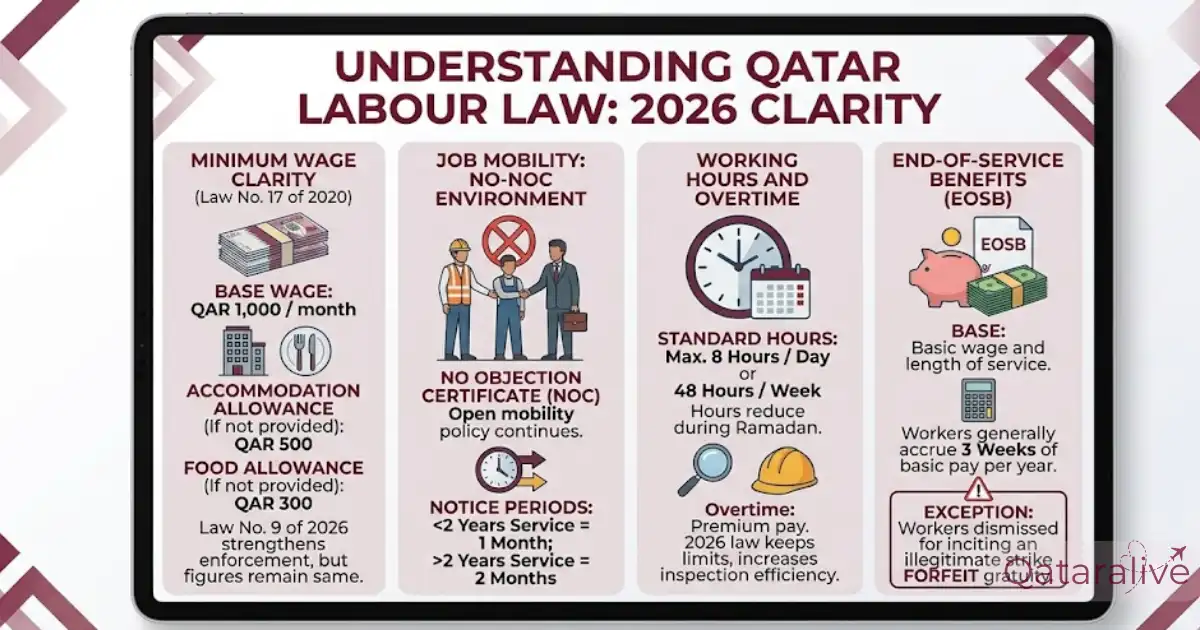
Qatar’s minimum wage stays anchored to Law No. 17 of 2020. Workers are entitled to a base wage of 1,000 Qatari riyals (QAR) a month.
Employers who do not provide housing must add a 500 QAR accommodation allowance. Employers who do not provide meals must add a 300 QAR food allowance.
Law No. 9 of 2026 does not change these figures, but it strengthens enforcement around them.
Job Mobility: The No-NOC Environment
Qatar removed the No Objection Certificate (NOC) requirement for job changes in earlier reforms. This open mobility policy continues under the 2026 law.
Workers can switch employers once notice periods are honored. Notice stays at one month for staff with up to two years of service, and two months for longer tenure. The update has made it easy to notify change of job.
Read how to get a job in Qatar.
Working Hours and Overtime
Standard hours remain capped at eight hours a day or 48 hours a week outside Ramadan. Hours reduce during the holy month, as before.
Overtime still requires added pay above the standard rate. The 2026 law keeps these limits intact but sharpens the inspection tools used to catch violations.
End-of-Service Benefits (EOSB)
End-of-service gratuity still uses basic wage and length of service as its base. Workers generally accrue three weeks of basic pay per year worked.
One exception now applies. Workers dismissed for inciting an illegitimate strike forfeit their gratuity under the new disciplinary rules.
Use this calculator to calculate your Gratuity.
Mandatory Health Insurance and Social Security
Health coverage and social security sit alongside the Labour Law. The Ministry has linked the 2026 reforms to Qatar’s wider worker welfare goals under Vision 2030.
Health Insurance Mandate
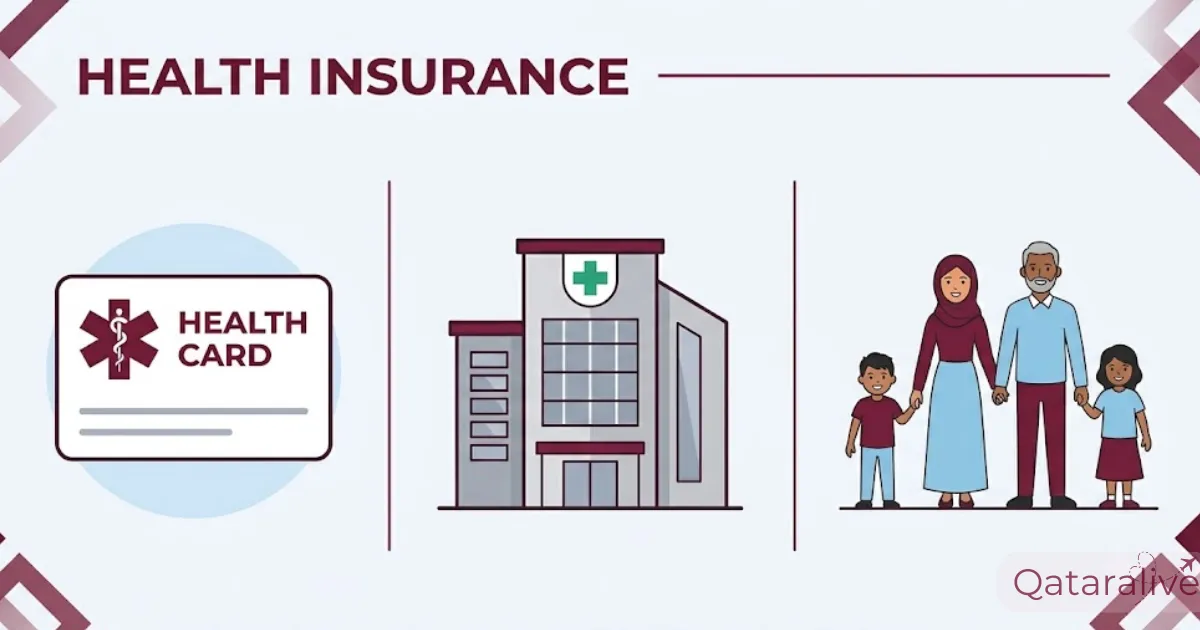
Employers must give workers access to healthcare, mainly through the Seha national scheme and employer-provided plans. The Ministry’s June 2026 statement did not announce a separate new insurance mandate inside Law No. 9.
The reforms instead tie worker welfare to the goal of a more attractive, stable business environment. Further insurance-specific guidance may still follow.
You can use your QID instead of health card.
Plan Structure
Employer plans typically cover inpatient and outpatient care. Coverage levels vary by sector, company size, and employee grade.
Businesses should confirm renewal terms with licensed insurers every year. Coverage gaps are a common finding during labour inspections.
Universal Coverage for Expats
Health card access links to a valid residence permit. Expats generally gain coverage once their employer completes visa and Qatar ID steps.
Employers should treat fast visa processing as a health coverage issue, not only an immigration task. Delays leave new hires without a valid health card.
Social Security Contributions
Social security contributions apply to Qatari nationals through the General Retirement and Social Insurance Authority. Non-Qatari employees are not covered by this pension system.
Non-Qatari workers rely on end-of-service gratuity as their main retirement benefit instead. Employers with Qatari staff should verify contribution rates match current Authority rules.
How to register on Ooredoo app.
Evolution of Qatar’s Labour Market: Vision 2030
The Ministry has framed the 2026 amendments as a response to Qatar National Vision 2030. That vision calls for a diversified, knowledge-based economy with a flexible labour market.

The Ministry cited three goals behind the reforms. These are stronger regulatory flexibility, better service efficiency, and a fairer balance between employer and worker interests.
Three forces drive this shift. Qatar’s economy is moving beyond hydrocarbons toward finance, logistics, and tourism. Global investors also weigh labour transparency when picking where to expand, and Qatar is actively competing with the UAE and Saudi Arabia for that investment.
Nationalization Mandates (Qatarization 2.0)
Qatar continues to pursue Qatarization as part of its long-term workforce strategy. The policy aims to raise the share of Qatari nationals in private sector jobs.

The 2026 Nationalisation Award
Qatar regularly recognizes private employers that lead in hiring and promoting Qatari nationals. These awards run through Ministry-linked national employment initiatives.
Employers building 2026 workforce plans should track upcoming award cycles. Strong Qatarization performance increasingly affects eligibility for government tenders.
Workforce Target Shift
Strict Qatarization targets apply mainly to banking, energy, telecoms, and government-linked entities. Small and medium private businesses generally face lighter obligations.
Employers should confirm their exact sector quota directly with the Ministry. Targets adjust periodically and are not fixed inside the Labour Law text.
A Stronger Regulatory and Enforcement Framework
Enforcement is a clear theme across the 2026 amendments. The Ministry explicitly tied the reforms to expanded compliance tools.
Enhanced Enforcement Powers
Inspectors now hold broader authority against non-compliant employers. New or expanded tools include suspending government services and publishing violators’ names in specified cases.
Automated Monitoring
Labour dispute committees now use electronic case systems. Their decisions carry enforceable legal authority once issued.
This shift means employers should expect faster detection of wage and contract gaps. Manual paperwork review is giving way to system-level checks.
Penalties for Non-Compliance
Fines for failing to form a required joint committee range from QAR 2,000 to QAR 5,000. Beyond fixed fines, service suspension can block new work permits entirely.
That suspension power makes it one of the strongest compliance levers in the amended law. It can halt hiring and renewals until violations are resolved.
New Licensing Requirements for Regulated Professions
Law No. 9 of 2026 adds a new Article 23 bis. It requires workers in designated vocational trades to hold a training and exam certificate from a Ministry-accredited centre before starting work.
This targets skilled trades where safety and quality depend on proven competence. Employers hiring into these categories should build certification time into recruitment timelines.
More Robust Protection of Confidential Business Interests
Qatar’s amendments strengthen how employers protect trade secrets and client relationships after a worker leaves.
Noncompete Clauses
Noncompete duration rose from one year to two years. This restores a longer standard that existed before the 2020 amendments shortened it, and it also removes the old sector-specific limit.
Two safeguards balance this change. A noncompete clause only works with Ministry of Labour approval, and it becomes void automatically if employment ends during probation.
Employers should update contract templates now. Older noncompete language may no longer be enforceable as written.
Mandatory Conciliation Before Labour Disputes
Faster dispute resolution is a headline goal of the 2026 reforms. Enhanced mediation procedures aim to resolve issues before they reach formal litigation.
Electronic Dispute Resolution
Labour dispute committees rely more on digital platforms for filing, evidence, and scheduling. Decisions issued this way carry enforceable legal authority.
Employers should assign one HR or legal contact to monitor electronic filings. Digital case management shortens response windows compared with paper processes.
Detailed Statutory Framework for Strikes
Qatar’s Labour Law still recognizes the right to strike. The 2026 amendments add much more structure around when a strike is lawful.
Right to Strike
A strike is lawful only after an employer breach that remains unresolved through amicable settlement or the prescribed collective dispute process. Workers must give written notice to both the employer and the Ministry.
Strikes are capped at six working days and limited to the workplace or worker accommodation. They must stop once formal collective proceedings begin, and strike days go unpaid.
Employers may bring in temporary replacement workers with Ministerial approval. The Minister also gained power to name additional vital facilities where strikes stay banned.
New Disciplinary Ground for Qatar labour law
The amendments create one new category of serious misconduct tied to unlawful strike activity.
Summary Dismissal
Employers can now dismiss a worker without notice or gratuity for inciting others to strike illegitimately in a way that disrupts operations. This is a narrow, specific ground rather than a general expansion of termination rights.
Employers should apply it carefully with documented evidence. Misuse of this ground could itself trigger a labour dispute claim.
Joint Committees Required Only for Larger Employers
Establishments with 100 or more workers must now form a joint employer-worker committee. This raises the earlier threshold, where committees were optional starting at 30 workers.
Smaller employers below 100 workers are not required to form one. They may still choose to do so voluntarily.
Employers crossing the 100-worker mark should prioritize committee formation. Non-compliance carries a fine of QAR 2,000 to QAR 5,000.
Increased Oversight of Overseas Recruitment
Recruitment practices, especially for workers hired abroad, face significant new scrutiny.
Manpower Agencies
The Ministry tightened licensing rules, operational standards, and penalties for recruitment offices. The stated goal is better service quality for employers and households alike.
Employers relying on third-party agencies should confirm current, valid licenses before new hiring campaigns. This applies most directly to domestic and semi-skilled labour recruitment.
Mandatory Digitalization: MoL E-Contract System
Digital processes run through most of the 2026 reform package. Electronic government contracts let workers sign agreements before traveling to Qatar, through Qatar Visa Centers in their home countries.
Dispute committees, wage monitoring, and some compliance reporting increasingly rely on electronic systems. Employers should treat digital readiness as a compliance requirement, not a convenience.
Labour Law Impact Assessment: Expats vs Employers
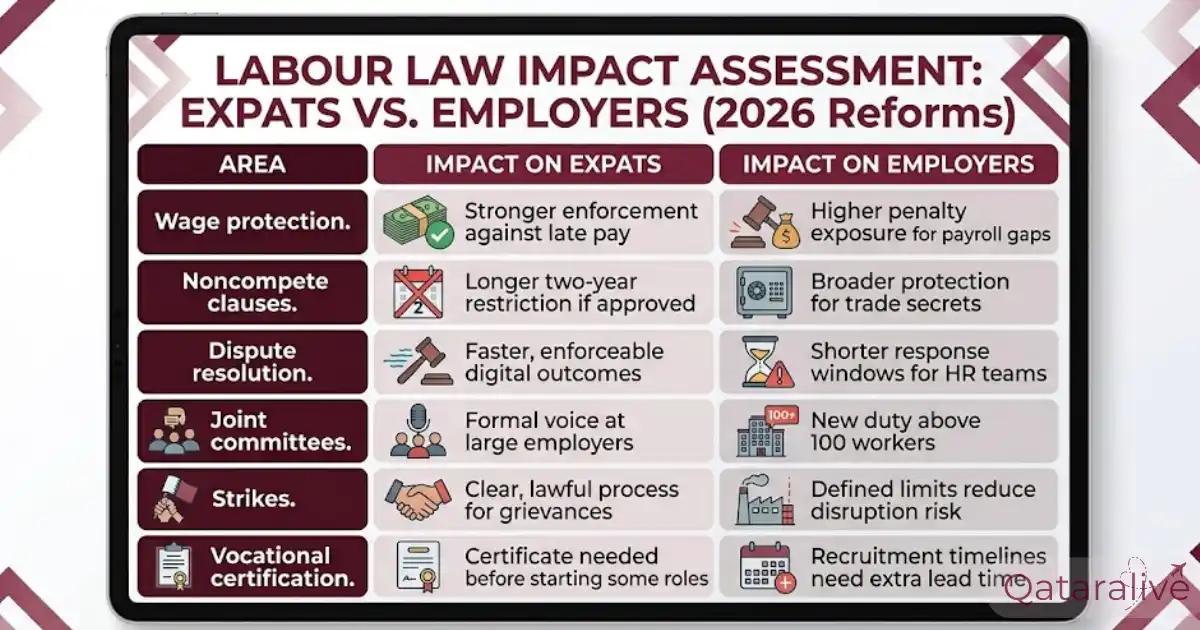
The Qatar Labour Law Reforms 2026 create distinct effects depending on which side of the employment relationship you sit on.
Area | Impact on Expats |
|---|---|
Wage protection | Stronger enforcement against late pay |
Noncompete clauses | Longer two-year restriction if approved |
Dispute resolution | Faster, enforceable digital outcomes |
Joint committees | Formal voice at large employers |
Strikes | Clear, lawful process for grievances |
Vocational certification | Certificate needed before starting some roles |
Amendment in Wage Protection System rules
Qatar has introduced an amendment to its Wage Protection System (WPS) rules, changing the time frame employers have to transfer workers’ salaries. Under Minister of Labour Decision No. (50) of 2026, employers must deposit the wages of workers paid on a monthly or annual basis into their bank accounts through the WPS within seven days from the salary due date. The salary is considered due on the first day of each calendar month.
The updated decision also clarifies the payment schedule for other categories of workers, whose wages become due on the first day of every two-week period. The amendment was published in Qatar’s Official Gazette, Issue No. 15 of 2026, and takes effect from the day after its publication. The changes are intended to provide a clear payment framework and strengthen compliance with Qatar’s wage protection requirements.
For Expats
Workers gain a faster dispute path and stronger wage protection enforcement. Unpaid wage cases should move through the system more quickly than before.
The longer noncompete duration is a trade-off to understand before signing. A Ministry-approved two-year restriction can limit which employers a worker joins right after leaving a role.
For Employers
Employers face higher compliance stakes, with service suspension and public naming as explicit tools now. At the same time, employers gain stronger legal cover for confidential business information through the extended noncompete window.
Employers crossing the 100-worker mark take on a new structural duty. They must form a joint committee or face fines.
What Has Not Changed in 2026 with Labour Law Updates?
Several foundational rules remain untouched. The minimum wage structure of 1,000 QAR basic pay, 500 QAR accommodation, and 300 QAR food allowance stays in place.
Standard working hours of eight hours a day and 48 hours a week outside Ramadan are unchanged. Standard notice periods of one and two months also remain the baseline.
The abolition of the NOC requirement continues under the new law. End-of-service gratuity calculations stay the same outside the narrow strike-incitement exception.
Strategic Guidance: How to Navigate the 2026 Qatar Labour Market
Adjusting to the Qatar Labour Law Reforms 2026 works best as a structured project.
The Digital-First Compliance Audit
Start by reviewing every contract template against the amended noncompete, notice, and certification rules. Cross-check payroll against wage protection rules, since automated monitoring raises the chance of quick detection.
Confirm headcount against the 100-worker committee threshold. Verify recruitment agency licenses for any third-party hiring partners.
What Should Employers Do Now?
The Qatar Labour Law Reforms 2026 call for five practical steps. Update noncompete clauses to reflect the two-year maximum and Ministry approval step. Form joint committees where headcount meets or exceeds 100 workers.
Review disciplinary policy to include the new strike-incitement dismissal ground with proper documentation. Confirm vocational certification needs before extending job offers.
Monitor upcoming Ministry executive regulations closely. Several provisions, including part-time work rules, still depend on further implementing guidance.
Conclusion
The Qatar Labour Law Reforms 2026 modernize enforcement, disputes, and noncompete rules rather than rewriting the whole system. Minimum wage, standard hours, and open job mobility remain exactly as they were.
Employers should audit contracts, payroll, and recruitment partners now. Workers should weigh the stronger wage protections against the longer noncompete window before signing new agreements.
Further Ministry guidance on part-time work and noncompete approval procedures is still expected. Both sides should keep watching official Ministry announcements through the rest of 2026.