Stadium 974 Qatar: History, Location, Seating Map | Guide

Stadium 974 is a football stadium in Ras Abu Aboud, Doha, Qatar, approximately 10 kilometers (6.2 miles) east of central Doha and constructed using 974 recycled shipping containers. Officially opened on 30 November 2021, This stadium made history as the first fully demountable stadium in FIFA (Fédération Internationale de Football Association) World Cup history, with a capacity ranging between 40,000 to 44,089 spectators depending on configuration.
National Sports Day is going to be hosted on 10th Feb 2026 by MOI and Lekhwiya and its been announced as a Public holiday in Qatar.
Welcome to Qatar
Welcome to Qatar, a nation where Stadium 974 represents innovation in sustainable architecture and modern football venue design. Qatar’s international dialing code is +974, which directly inspired both the stadium’s name and design concept.
The stadium is located in the Ras Abu Aboud district along the Arabian Gulf coastline, offering spectacular views of Doha’s West Bay skyline and serving as a gateway to Qatar’s maritime heritage and contemporary sports infrastructure.
Design and Construction of Stadium
Fenwick Iribarren Architects led the design with specialist partners.
Schlaich Bergermann Partner and Hilson Moran provided engineering input.
Construction was managed by HBK Contracting Company, DCB-QA, and Time Qatar.
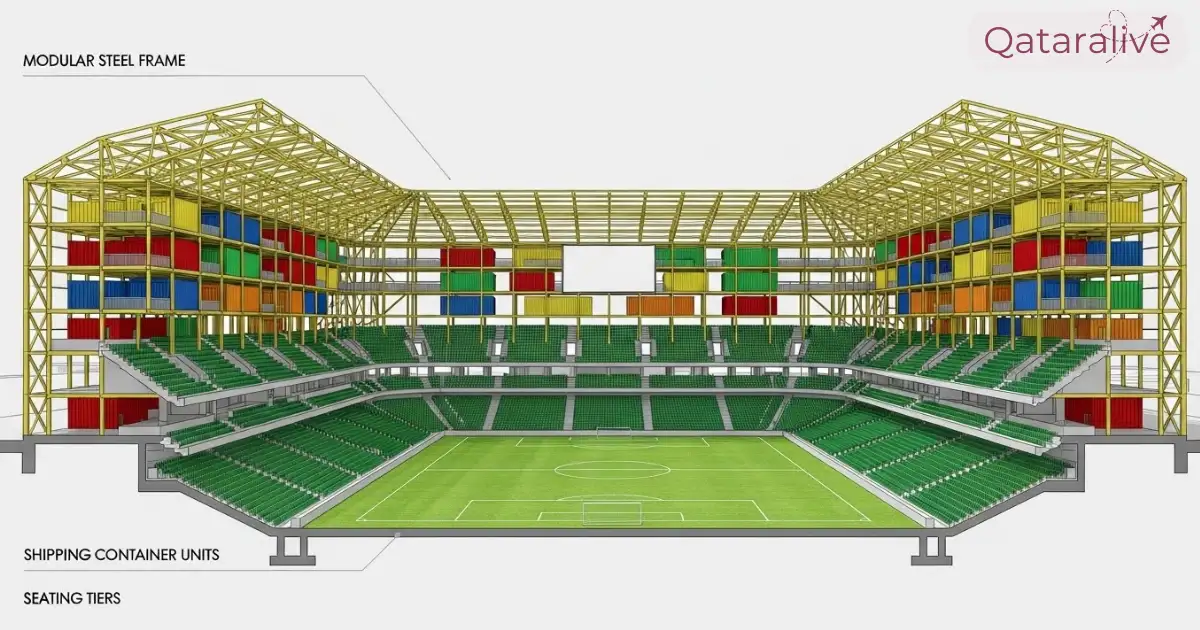
The stadium uses 974 repurposed shipping containers and modular steel elements.
It has a two-tier layout divided by luxury box sections.
Floor area is 93,200 square metres (1,003,129 square feet).
Gross volume equals 563,600 cubic metres (19,901,651 cubic feet).
Procurement began in 2017 and environmental site work started in October 2017.
Main construction began on 1 November 2019.
The primary structure finished in March 2021.
History
It was initially announced under the name Ras Abu Aboud Stadium and officially renamed during a virtual launch event on 20 November 2021. The stadium hosted its first match on 30 November 2021 during the 2021 FIFA Arab Cup opening day between the United Arab Emirates and Syria, achieving a 2-1 result.
Construction time for Stadium was approximately 3 years from groundbreaking to completion, establishing new benchmarks for temporary sports infrastructure.
Highlights of the Stadium
Stadium 974 stands out for three main reasons:
The Number 974
It represents both Qatar’s international dialing code (+974) and the exact quantity of shipping containers used in construction, creating a double symbolic meaning that honors the nation’s identity.
Stadium 974’s name was revealed during the November 2021 launch event, replacing the original Ras Abu Aboud Stadium designation and emphasizing the venue’s unique modular construction methodology.
Maritime Tribute
Stadium pays tribute to Doha’s maritime heritage through its strategic portside location, shipping container architecture, and proximity to the harbor located directly in the neighborhood.
The distinctive, boldly colorful arena echoes the nearby port and Doha’s longtime seafaring traditions, with containers customized to include concession stands, restrooms, and seating areas positioned to maximize views of the Arabian Gulf.
FIFA First
Stadium 974 became FIFA’s first fully demountable covered football stadium, setting unprecedented standards for cost-effective sustainability and temporary sports venue design.
The stadium received the 2022 IABSE Award for Innovation in Construction and the BIM AWARD 2023 second prize in the category BIM GOES GREEN, demonstrating international recognition for its revolutionary approach to stadium architecture.
Stadium 974 Location and How To Reach?
Stadium 974 is located in Ras Abu Aboud, Doha, Qatar, approximately 10 kilometers (6.2 miles) east of central Doha on a 450,000 square-meter (111-acre) waterfront site near the Port and Hamad International Airport.
The stadium’s address is Ras Abu Aboud, Doha, Qatar, situated adjacent to the Ras Bu Abboud Expressway with views overlooking Doha’s West Bay skyline and positioned a few kilometers from the eastern end of the Corniche and less than 2 kilometers (1.2 miles) from the National Museum of Qatar.
Reaching Stadium 974 By Doha Metro
Reaching Stadium 974 By Car
Parking Facilities
Reaching Stadium 974 By Taxi, Uber, Careem
Stadium 974 Seating Map
Stadium offers around 44,089 seats for FIFA WC 2022 and subsequent tournaments, arranged in a compact rectangular bowl with two primary seating tiers and a continuous roof ring.
The seating is split into eight structural sectors, each containing lower and upper stand modules that can be dismantled and reassembled in new configurations.
Seating is organised in four broad ticket categories that mirror FIFA’s global stadium standard.
Hospitality suites, VIP lounges and media tribunes occupy the mid‑tier on the west side, with skyboxes and press facilities integrated into container modules overlooking the halfway line.
Accessible seating is distributed along the main concourse level, giving wheelchair users and companions clear sightlines from multiple sides of the pitch and step‑free access from lifts and ramps.
Colour‑coded seating and exposed containers make it easy for fans to navigate to blocks, with clear signage and digital wayfinding used during major events.
A Brief, Action-Packed Life
Stadium operational life has been intense despite a relatively short calendar span from late 2021 to at least early 2025.
It relied on natural ventilation and avoided artificial cooling systems.
Sea breezes from the Arabian Gulf helped cool the venue.
Tournament Summary
Stadium 974 hosted matches across 5 major tournaments, establishing itself as a versatile venue for international football competitions despite its temporary designation.
Year | Tournament | Fixtures hosted |
|---|---|---|
2021 | FIFA Arab Cup | 6 fixtures |
2022 | FIFA World Cup | 7 fixtures |
2024 | FIFA Intercontinental Cup | 2 fixtures |
2024 | Trophée des Champions | 1 fixture |
2025 | FIFA Arab Cup | 4 fixtures |
2021 FIFA Arab Cup
During the 2021 FIFA Arab Cup, Stadium staged six matches.
2022 FIFA World Cup
Stadium hosted seven matches at FIFA WC 2022, all in the evening, taking advantage of natural ventilation from the Gulf.
2024 FIFA Intercontinental Cup
In December 2024 Stadium became one of the venues for the re‑launched FIFA Intercontinental Cup, complementing Lusail Stadium, which hosted the final involving Real Madrid.
2025 FIFA Arab Cup
During the 2025 FIFA Arab Cup, this Stadium again served as a group‑stage venue.
Post-World Cup
Legacy plans originally suggested that Stadium would be dismantled after FIFA WC 2022 and reassembled abroad, with Maldonado in Uruguay discussed as a candidate host for a future 2030 FIFA World Cup bid, alongside options to relocate the structure to an African country.
Subsequently, FIFA confirmed a 2030 World Cup hosting plan centred on Spain, Portugal and Morocco, with opening centenary games in South America, and the Uruguay, Argentina, Chile, Paraguay bid did not proceed.
ESPN reporting and the updated Stadium 974 profile show that, as of December 2025, the stadium remains on its original Ras Abu Aboud site, still carrying World Cup branding while being reused for tournaments like the 2024 Intercontinental Cup, the 2024 Trophée des Champions and the 2025 FIFA Arab Cup.
Legacy and Sustainability
Stadium embodies Qatar’s goal to link sports infrastructure with long‑term sustainable design benchmarks rather than short‑term event construction.
The GSAS 5‑Star certifications, demountable structure and water‑efficient systems position the venue as a reference project for modular, low‑waste stadiums that can be adapted, moved or broken down into smaller community facilities in Africa, South America or other regions.
Key Sustainability Highlights:
Together, these measures align Stadium 974 with Qatar National Vision 2030 goals around resource efficiency and sustainable urban development.
Nearby Attractions
Stadium is surrounded by 4 major attractions within walking distance or short drives: the Mina District (Old Doha Port), luxury cruise terminals, Box Park, and La Cigale Hotel, providing entertainment and accommodation options for visitors.
The Picture-Perfect Mina District
The Mina District is a Mediterranean-inspired neighborhood. It features pastel-coloured buildings and cobblestone streets.
Dining options exceed 50 restaurants and cafes.Shops number around 100 retail and gift outlets.
Highlights include the Chabrat Al Mina fish market and waterfront dining.
Visitors can see World Wide Walls street art and the Flag Plaza.
A Luxury Cruise Destination
Old Doha Port functions as Doha’s main cruise terminal, receiving ships such as MSC World Europa and other international liners during the winter season.
Fans staying on cruise ships during tournaments can reach Stadium within minutes by shuttle, car or a short taxi ride along the Corniche.
Visitors enjoy promenade views of ships and yachts.
Box Park
Box Park is a waterfront development near Old Doha Port that converts colourful shipping containers into cafés, shops and viewing platforms facing the sea and skyline.
The visual link between Box Park’s stacked containers and Stadium 974’s container façade reinforces the district’s identity as a hub of contemporary container architecture along the Corniche.
La Cigale Hotel
La Cigale Hotel, Managed by Accor, is a 5‑star property in the Al Sadd area, roughly 7–9 km (4–5.5 mi) west of Stadium 974, with convenient access to central Doha, Souq Waqif and Msheireb Downtown.
Guests can reach Stadium 974 in about 15–20 minutes by car or taxi via Suhaim Bin Hamad Street and main city arteries leading to Ras Bu Abboud Expressway.