Ramadan 2026 Working Hours for Private & Public Sectors Guide
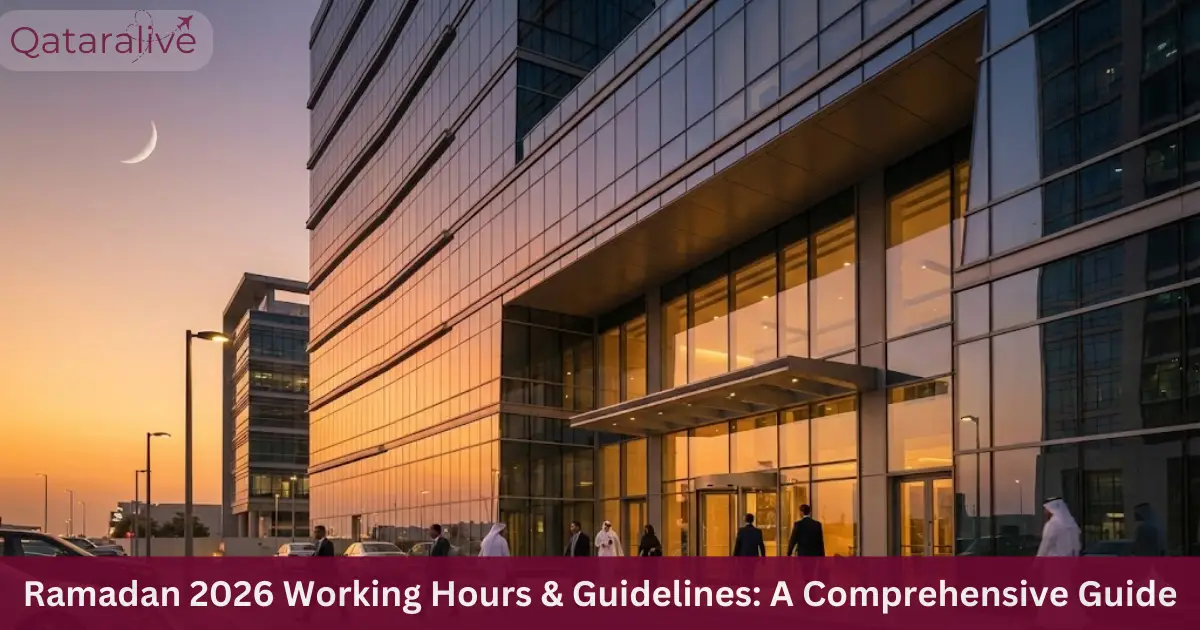
Ramadan 2026 working hours in Qatar are capped at 36 hours per week and 6 hours per day for private sector employees. The Ministry of Labour announced reduced working hours on February 14, 2026, in accordance with Qatar Labour Law Article 73. Government sector employees work 5 hours daily during Ramadan 2026.
MoPH announces Hajj 2026 vaccination requirements.
Official Working Hours Qatar During Ramadan 2026
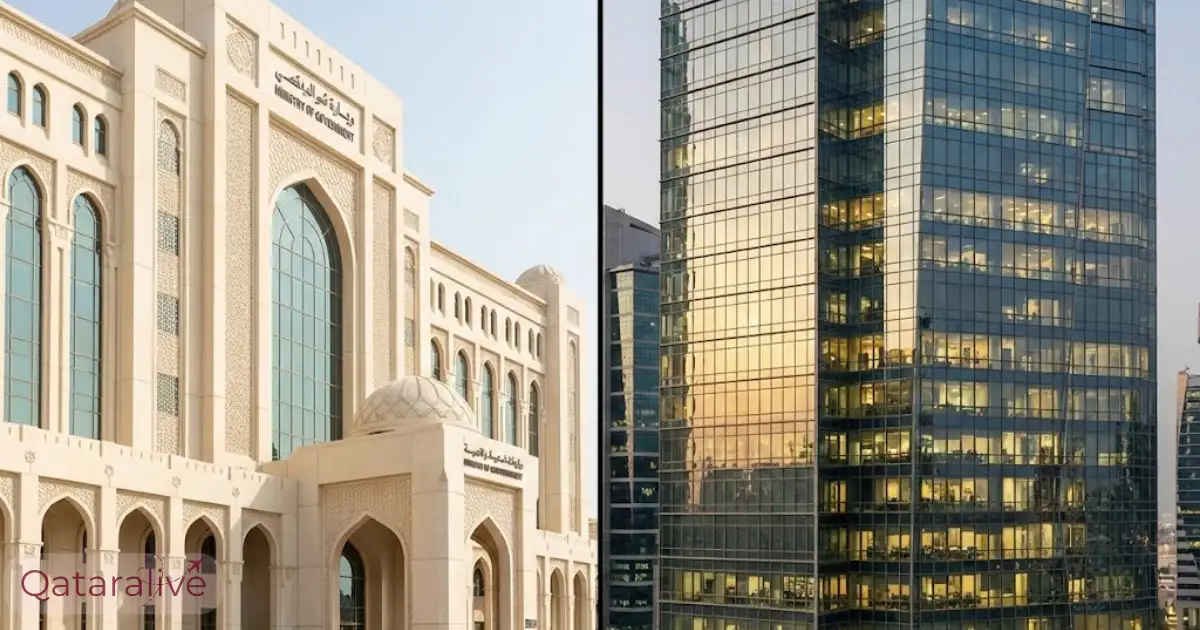
Private Sector Working Hours
Private sector employees in Qatar work maximum 36 hours per week and 6 hours daily during Ramadan 2026. The Ministry of Labour’s announcement applies to all private companies. Employers must comply with these caps or face penalties for labour law violations.
Common private sector schedules include:
The reduction in working hours during Ramadan applies to all employees regardless of religion or nationality. This distinguishes Qatar from some GCC countries that limit reductions to Muslim employees only.
The Amiri Diwan officially announced the Eid Al Fitr 2026 holidays.
See the Final Notifications and hours schedules from your HR departments.
Government Sector Working Hours
Government sector employees work 5 hours daily during Ramadan 2026. Standard government office hours run 9:00 AM to 2:00 PM, Monday through Thursday. Friday working hours are 9:00 AM to 12:00 PM. Government employees receive full salaries despite reduced Ramadan working hours.
Essential Services Schedules
Essential service employees maintain 24-hour operations through shift rotations.
Ministry of Interior
Ministry of Interior (MOI) services continue 24 hours daily during Ramadan. Police, traffic department, civil defence, and emergency services maintain full operational capacity through shift rotations. Security cannot be compromised, so MOI personnel work regular shifts with possible schedule adjustments.
MOI administrative offices serving the public typically operate from 8:00 AM to 2:00 PM during Ramadan. Services like Qatar ID renewal, vehicle registration, and licensing follow reduced hours. Online services through MOI apps remain available 24 hours without interruption.
Traffic police increase patrols during iftar time (30 minutes before sunset). Accident rates historically spike as fasting drivers rush home, so MOI deploys extra officers during this critical period. Stricter enforcement of speed limits and distracted driving rules protects public safety.
Hamad Medical Corporation (HMC)
Hamad Medical Corporation (HMC) emergency services operate 24 hours during Ramadan. Emergency rooms, intensive care units, ambulance services, and critical care departments maintain full staffing through shift rotations. Healthcare cannot pause for Ramadan, so essential medical personnel work regular hours with schedule flexibility where possible.
Public Transport working hours in Ramadan
Doha Metro extends operating hours during Ramadan to accommodate changed travel patterns.
Karwa public buses adjust routes and frequencies for Ramadan. Morning buses maintain regular schedules for reduced work hours. Evening buses increase frequency from 6:00 PM to 11:00 PM, matching the surge in post-iftar activity. See how to get your Karwa Card or how to recharge karwa card.
Taxi services like Karwa experience peak demand in two daily windows. The first peak occurs 4:00 PM to 6:00 PM as people rush home for iftar. The second peak runs 8:00 PM to 11:00 PM as residents visit family, attend prayers, or go shopping. See how to book the Robo Taxi or Karwa Taxi.
Salary During Ramadan – Full Pay Guarantee
Employees receive full salaries during Ramadan despite reduced working hours in Qatar. Qatar Labour Law guarantees no salary reduction when Ramadan working hours decrease from standard 8-hour days to 6-hour days (private sector) or 5-hour days (government sector).
Overtime rules during Ramadan:
Leave entitlements during Ramadan:
Employer Penalties for Violations
Employers violating Ramadan working hour regulations face penalties under Qatar Labour Law. The Ministry of Labour enforces compliance through inspections and employee complaints.
Violation penalties include:
How to report violations: Employees can file complaints through the Ministry of Labour’s online portal or by visiting any labour department office. The complaint process protects employee identity and prevents retaliation.
Ramadan working hours 2026 Gulf Region
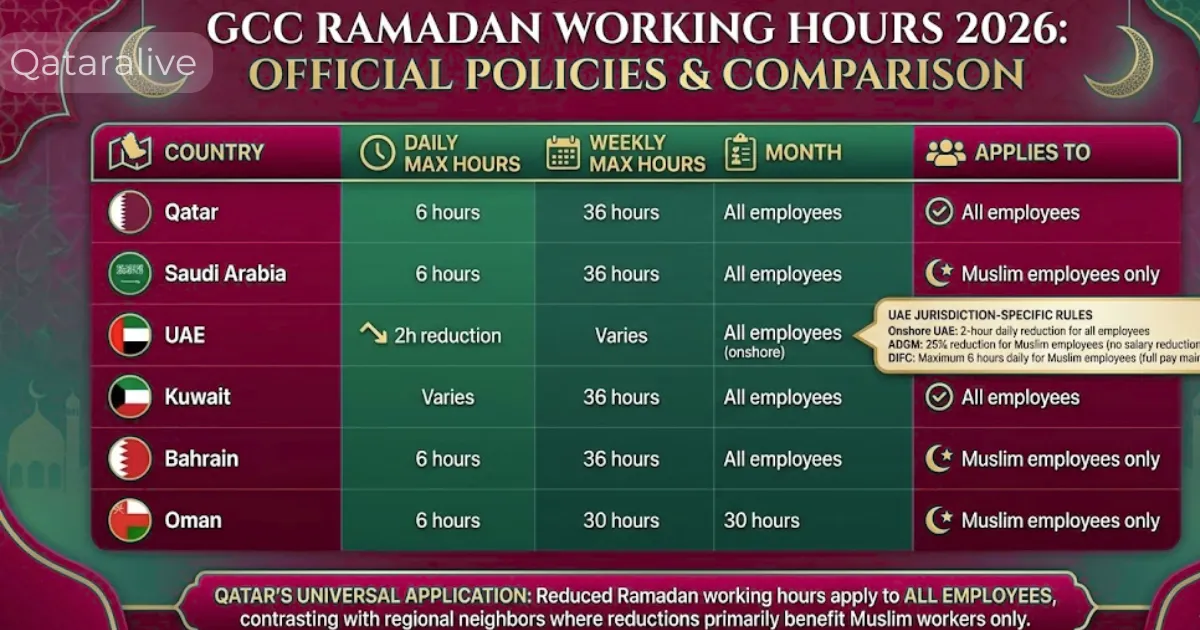
GCC countries implement varied Ramadan working hour policies. The table below compares official Ramadan timings across Gulf Cooperation Council nations for 2026.
Country | Daily Max | Weekly Max | Applies To |
|---|---|---|---|
Qatar | 6 hours | 36 hours | All employees |
Saudi Arabia | 6 hours | 36 hours | Muslim employees only |
UAE | 2h reduction | Varies | All employees (onshore) |
Kuwait | Varies | 36 hours | All employees |
Bahrain | 6 hours | 36 hours | Muslim employees only |
Oman | 6 hours | 30 hours | Muslim employees only |
UAE has jurisdiction-specific rules:
Qatar’s universal application of reduced Ramadan working hours to all employees differs from regional neighbors who limit reductions to Muslim workers only.
Ramadan 2026 Dates & Calendar Qatar
The Qatar Calendar House predicts Ramadan 2026 begins Wednesday, February 18, 2026, based on astronomical calculations. The Ramadan crescent appears Tuesday, February 17, 2026, at 3:02 PM Doha time. Official confirmation depends on the Crescent Sighting Committee at the Ministry of Awqaf and Islamic Affairs.
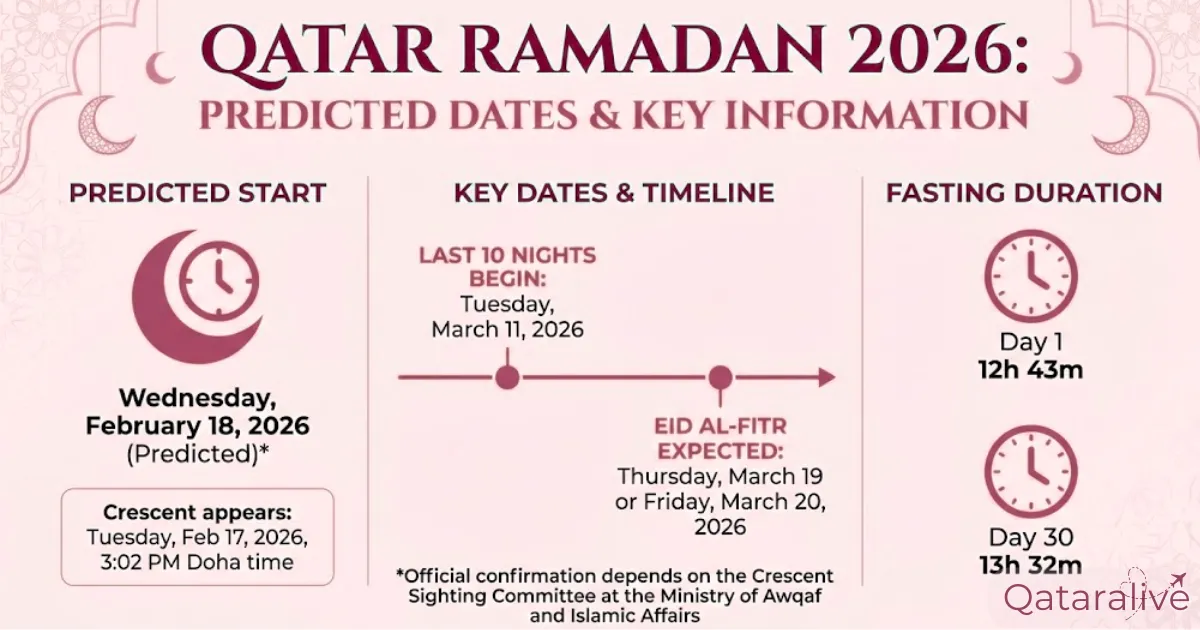
Key Dates:
Eid Al-Fitr will be a public holiday in Qatar, see the complete list for Public Holidays in Qatar 2026
Ramadan 2026 Prayer Timetable (Doha)
30-Day Scenario (Starting Feb 18):
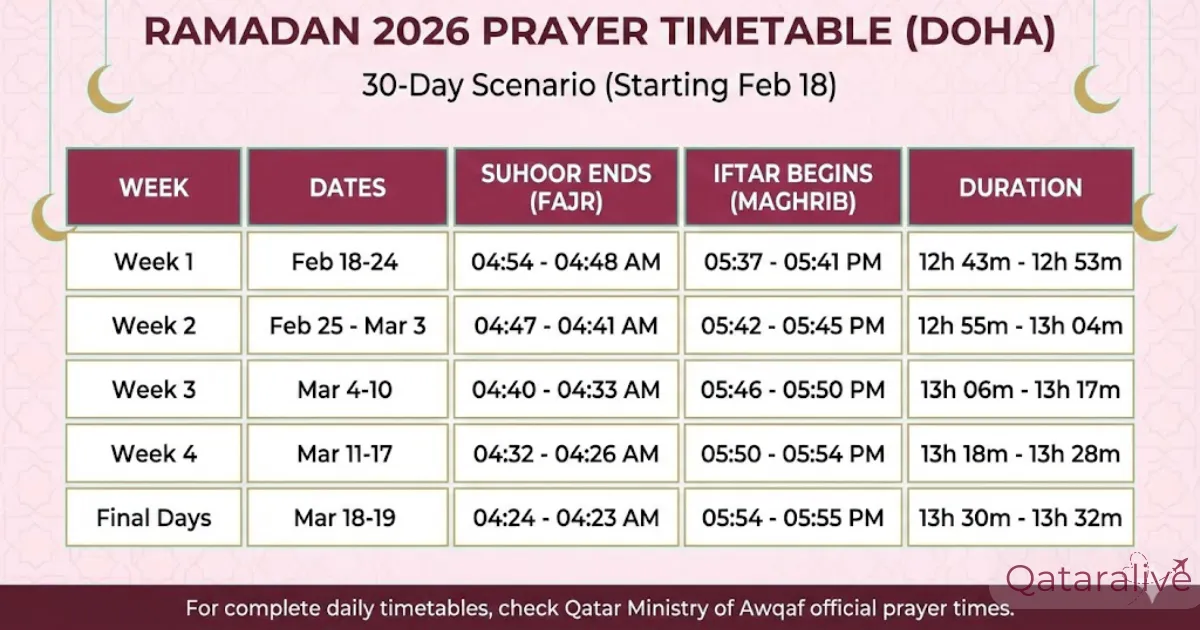
Week | Dates | Suhoor Ends (Fajr) | Iftar Begins (Maghrib) | Duration |
|---|---|---|---|---|
Week 1 | Feb 18-24 | 04:54 – 04:48 AM | 05:37 – 05:41 PM | 12h 43m – 12h 53m |
Week 2 | Feb 25 – Mar 3 | 04:47 – 04:41 AM | 05:42 – 05:45 PM | 12h 55m – 13h 04m |
Week 3 | Mar 4-10 | 04:40 – 04:33 AM | 05:46 – 05:50 PM | 13h 06m – 13h 17m |
Week 4 | Mar 11-17 | 04:32 – 04:26 AM | 05:50 – 05:54 PM | 13h 18m – 13h 28m |
Final Days | Mar 18-19 | 04:24 – 04:23 AM | 05:54 – 05:55 PM | 13h 30m – 13h 32m |
For complete daily timetables, check Qatar Ministry of Awqaf official prayer times.
Flexible Working Arrangements
Flexible working arrangements allow employees to adjust start and end times within the 6-hour daily requirement. Employers may offer flexibility for employees to begin work between 7:00 AM and 10:00 AM, completing 6 hours. Managers must approve flexible arrangements to ensure operational coverage.
Common flexible arrangements include:
Why flexibility matters during Ramadan: Ramadan office hours and flexible timing accommodate five daily prayers at specific times. Energy levels decline from 2:00 PM to 5:00 PM as dehydration accumulates. Flexible schedules let employees schedule demanding tasks during high-energy morning hours.
Remote Work Policy
Qatar government sector allows up to 30% of employees to work remotely on Fridays during Ramadan. Priority for remote work goes to Qatari mothers and persons with disabilities. Private sector remote work policies vary by company, as Qatar Labour Law does not mandate private employer remote work arrangements.
Remote work maintains the same hour requirements (6 hours private, 5 hours government). Employees working from home must complete assigned tasks and remain available during core business hours.
Workplace Responsibilities During Ramadan
Employee Responsibilities
Employees must adhere to announced Ramadan schedules and maintain work quality despite reduced hours. Coordinate flexible arrangements with managers in advance. Respect colleagues who may not be fasting by avoiding assumptions or pressure about religious observance.
Key employee actions:
Manager Responsibilities
Managers must implement Qatar Labour Law requirements consistently across teams. The 36-hour weekly cap and 6-hour daily maximum apply without exception. Managers cannot pressure employees to work beyond legal limits.
Manager priorities include:
What Not to Do During Ramadan in Qatar
Eating, drinking, or smoking in public during fasting hours is prohibited by law in Qatar. This ban applies to all people regardless of religion or nationality. The prohibition runs from Fajr (dawn) until Maghrib (sunset). Violators face fines up to QAR 3,000.
Behaviors to avoid during Ramadan:
Hotels and malls provide screened dining areas where non-fasting guests can eat during daylight hours. These designated sections respect both fasting observers and those who need daytime meals.
Driving caution: The 30 minutes before iftar sees elevated accident risk. Maintain safe speeds and anticipate less alert drivers rushing home.
Ramadan Customs and Workplace Etiquette
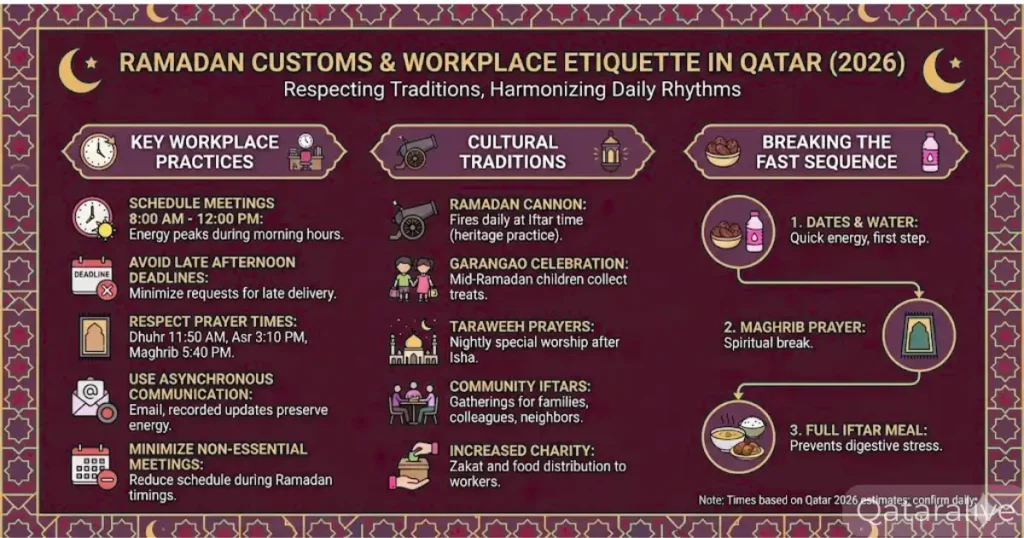
Ramadan transforms daily rhythms across Qatar through religious observance and cultural traditions. Understanding these customs creates respectful workplace environments.
Key workplace practices:
Cultural traditions include:
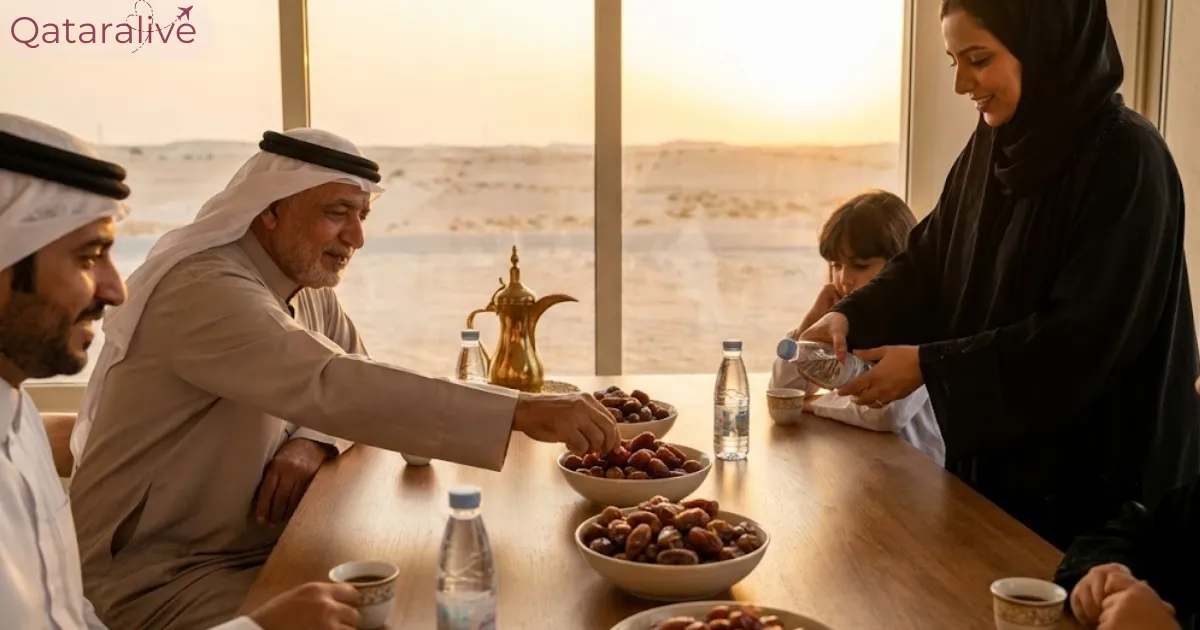
Breaking the fast follows Islamic tradition. Dates and water come first, followed by Maghrib prayer, then a full iftar meal. This sequence provides quick energy while preventing digestive stress.
Best Iftar & Suhoor Places in Qatar During Ramadan 2026

Top Ramadan Tents
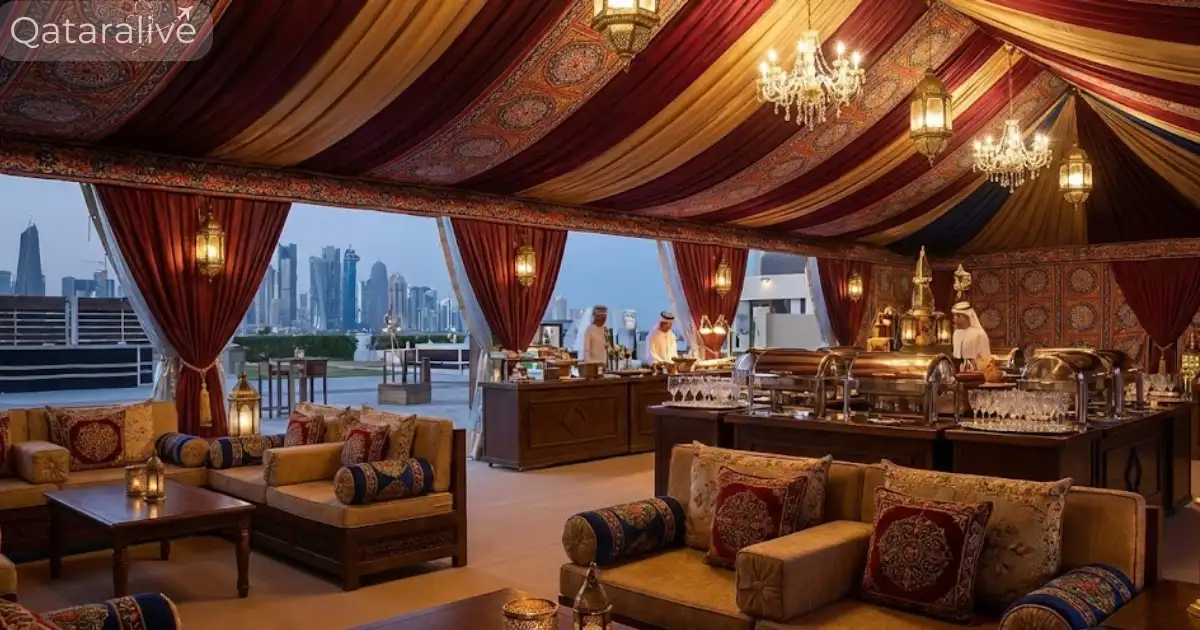
Luxury hotel Ramadan tents offer traditional Arabian hospitality with premium dining. These venues operate exclusively during Ramadan, creating once-yearly destinations.
Recommended Ramadan tents:
- The Ritz-Carlton Doha – Qatari, Lebanese, and international cuisine. Capacity 500 guests. Live oud music. Advance booking essential.
- Four Seasons Hotel Doha – International buffet with 25+ Arabic desserts. Beachfront location. Tableside chef preparations. Family play areas available.
- Mondrian Doha – Gulf cuisine with weekly themed nights (Moroccan, Egyptian, Turkish). Contemporary design. Live entertainment.
- St. Regis Doha – Elegant Middle Eastern buffet. 80+ dishes. Dedicated grill station. Private dining sections.
- Marriott Marquis City Center – Family-friendly with healthy options. Suhoor service 10:00 PM to 3:00 AM.
Best Restaurants
Iftar recommendations:
Suhoor recommendations:
Book early for last 10 nights when demand peaks.
Conclusion
Ramadan 2026 working hours in Qatar mandate 36 hours weekly and 6 hours daily for private sector, 5 hours daily for government sector. The Ministry of Labour enforces these regulations with penalties for violations. Employees receive full salaries despite reduced hours.
Ramadan begins February 18, 2026 (pending moon sighting), with Eid Al-Fitr expected March 19-20, 2026. This winter Ramadan features shorter fasting hours (12h 43m to 13h 32m) and cooler weather compared to summer observances.
Verify specific working hours with your employer, as schedules may vary within labour law limits. Monitor official announcements from the Ministry of Awqaf for confirmed start dates and Eid holidays.